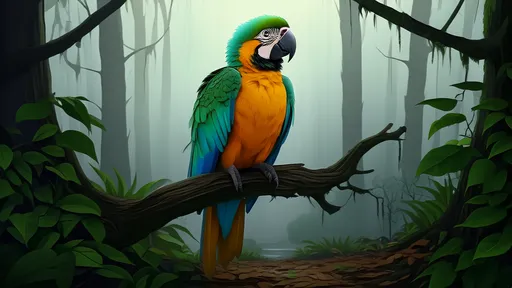
The mournful tale of the Carolina Parakeet, North America's only native parrot species, serves as a haunting reminder of humanity's complex relationship with nature. Once vibrant and abundant across the eastern United States, these emerald-green birds with their striking yellow and orange faces vanished forever in the early 20th century. Their extinction represents not just the loss of a single species, but the silencing of an entire ecological chorus that had echoed through American forests for millennia.
The Carolina Parakeet (Conuropsis carolinensis) was no ordinary bird. Flocking in noisy, colorful groups that could number in the hundreds, they brought a tropical splendor to temperate woodlands from New York to the Gulf of Mexico. Early naturalists like John James Audubon marveled at their beauty, painting them perched on sycamore branches or feeding on cockleburs. Their social nature made them extraordinary - they would famously rally around wounded flock members, a trait that ultimately contributed to their demise as hunters exploited this loyalty.
What makes their extinction particularly tragic was how rapidly it occurred. In the span of less than a century, the species went from being considered agricultural pests to becoming museum specimens. The last confirmed wild sighting occurred in 1904 in Florida, while the final captive bird, named Incas, died at the Cincinnati Zoo in 1918 - in the same cage where Martha, the last Passenger Pigeon, had died four years earlier. Two iconic American birds gone forever, their fates intertwined through human carelessness.
The causes of their extinction were manifold and reflect the changing relationship between humans and the natural world during the 19th century. Habitat destruction played a significant role as old-growth forests fell to the axe and plow. Their bright plumage made them targets for the millinery trade, as feathers adorned fashionable hats. Farmers shot them as crop pests, though modern analysis suggests their agricultural damage was likely exaggerated. Perhaps most surprisingly, their social nature made them vulnerable - when hunters shot one bird, others would remain nearby, allowing entire flocks to be slaughtered.
Cultural attitudes of the time viewed nature as an endless resource to be conquered and exploited. Conservation ethics were in their infancy, and the concept of endangered species hadn't yet entered public consciousness. The parakeet's decline happened so swiftly that by the time scientists recognized the danger, it was already too late. Unlike the Passenger Pigeon, which received some belated conservation attention, the Carolina Parakeet slipped away almost unnoticed by the general public.
Modern science has revealed fascinating details about this lost species through museum specimens and historical accounts. Unlike tropical parrots, Carolina Parakeets were adapted to seasonal changes, potentially migrating locally to follow food sources. Their diet included the seeds of cockleburs and other plants now considered weeds, making them important seed dispersers. Recent genetic studies suggest they were more closely related to South American parakeets than to the thick-billed parrots of the American southwest, raising questions about how and when they came to inhabit eastern North America.
The ecological consequences of their disappearance remain largely unstudied, but were likely significant. As seed dispersers, their absence may have altered forest composition. Their nesting habits - using tree cavities - put them in competition with other species, and their removal may have affected entire communities of cavity-nesting animals. The silencing of their raucous flocks changed forever the soundscape of American forests, removing a voice that had been part of the continent's natural symphony for thousands of years.
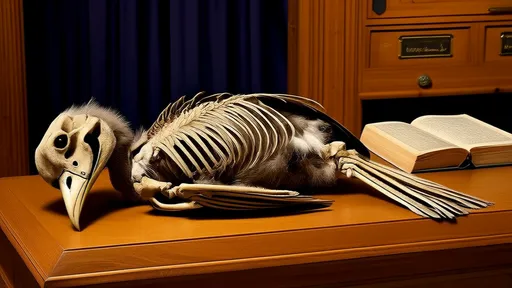
Today, the Carolina Parakeet exists primarily in museum drawers and historical accounts, a ghost of American biodiversity. A few taxidermied specimens stare blankly from glass cases, their vibrant colors faded with time. Occasionally, unconfirmed sightings surface, sparking brief hope before being dismissed as escaped pet birds. Their story serves as a cautionary tale about extinction - not as some abstract concept, but as a real, irreversible loss that happens quietly, often before we realize what's occurring.
The parallels to current conservation challenges are impossible to ignore. Habitat loss, climate change, and human exploitation continue to threaten species worldwide. What makes the Carolina Parakeet's story particularly poignant is that its extinction was entirely preventable with even basic conservation measures. Their tragedy helped shape modern wildlife protection laws, though too late for their own survival.
In an age of accelerating biodiversity loss, the Carolina Parakeet stands as an avian canary in the coal mine - a vivid reminder of what happens when we fail to recognize our impact on the natural world. Their absence leaves questions we can never answer: What secrets might their behavior have revealed about avian intelligence? How did their unique adaptations to temperate climates evolve? What role did they truly play in their ecosystems? These mysteries died with the last individual, a sobering reminder of the finality of extinction.
Perhaps the greatest lesson from the Carolina Parakeet lies not in its disappearance, but in what its existence tells us about North America's ecological past. That parrots once flew freely in New York and Virginia seems fantastical today, a reminder of how dramatically we've altered the continent's biological fabric. Their story challenges us to imagine a wilder America, one where emerald flashes still brighten eastern forests and raucous parrot calls still echo across southern swamps - an America that might have been, had we acted differently.
As climate change reshapes habitats and human pressures on wildlife intensify, the ghost of the Carolina Parakeet whispers a warning from the past. In museums, their preserved bodies serve as biological artifacts, but their true legacy lives in the conservation movements they helped inspire. Though we cannot bring them back, we can ensure that other species don't follow their path into oblivion. The silence left by their absence speaks volumes about our responsibility to protect what remains of nature's diversity.

By /Aug 12, 2025
By /Aug 12, 2025

By /Aug 12, 2025

By /Aug 12, 2025

By /Aug 12, 2025

By /Aug 12, 2025
By /Aug 12, 2025

By /Aug 12, 2025

By /Aug 12, 2025
By /Aug 12, 2025

By /Aug 12, 2025
By /Aug 12, 2025
By /Aug 12, 2025
By /Aug 12, 2025

By /Aug 12, 2025

By /Aug 12, 2025

By /Aug 12, 2025

By /Aug 12, 2025

By /Aug 12, 2025

By /Aug 12, 2025