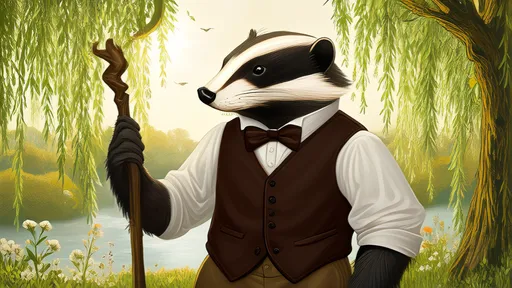
In the quiet corners of English literature, certain characters emerge not merely as figments of imagination but as mirrors to society. Kenneth Grahame’s The Wind in the Willows is one such work, where the animal inhabitants of the riverbank embody deeper truths about human nature and social structures. Among them, Badger stands out as a particularly resonant figure—a stoic, solitary creature whose presence whispers of the unspoken hierarchies and traditions that have long defined British society.
Badger is the archetype of the old guard, a creature of habit and authority. He resides in the Wild Wood, a place untouched by the frivolities of the riverbank, much like the landed gentry of England who have historically distanced themselves from the bustling changes of urban life. His home, a labyrinth of tunnels and chambers, is a fortress of tradition, impervious to the whims of modernity. There is an air of quiet superiority about him, not unlike the unspoken privilege of the aristocracy. He does not seek power, yet it is understood that his word carries weight. When he speaks, even the impulsive Toad and the spirited Mole listen.
What makes Badger so compelling is his duality—he is both a recluse and a leader. He prefers solitude, yet he steps forward when the community is in disarray, much like the British upper class, which often retreats into its estates but reemerges in times of crisis to guide or govern. His intervention in Toad’s reckless behavior is not just an act of friendship but a restoration of order. In this way, Badger becomes a natural metaphor for the paternalistic role of the aristocracy, a class that sees itself as the steward of societal stability.
The contrast between Badger and the other characters further underscores his symbolic role. Toad, with his flamboyance and recklessness, represents the nouveau riche—wealthy but lacking in restraint or wisdom. Ratty, the cultured and contented water vole, embodies the middle class, comfortable in his routines but occasionally drawn to adventure. Mole, the humble and loyal friend, is the everyman, navigating a world he doesn’t always understand. Badger, however, exists above these dynamics. He is neither envious of Toad’s wealth nor intrigued by Ratty’s wanderlust. His authority is innate, a product of his lineage and the respect it commands.
Grahame’s portrayal of Badger is steeped in nostalgia for a vanishing England. Written in 1908, The Wind in the Willows captures a moment when the rigid structures of the Victorian era were beginning to fray. The motorcars that Toad adores were symbols of a new, faster world—one that Badger instinctively distrusts. His disdain for modernity is not merely curmudgeonly; it reflects a deeper anxiety about the erosion of tradition. In this sense, Badger becomes a melancholic emblem of a fading order, one that Grahame himself seems to mourn.
Yet Badger is not a relic. His wisdom and strength are timeless, and his role in the story is ultimately redemptive. He is the one who orchestrates Toad’s rehabilitation, who rallies the animals to reclaim Toad Hall from the weasels and stoats—creatures that represent the chaotic underclass threatening the established order. This narrative arc reinforces the idea that the aristocracy, for all its flaws, is still necessary to maintain harmony. It is a conservative vision, but one that Grahame renders with such warmth and charm that it feels less like propaganda and more like a fairy tale.
The enduring appeal of Badger lies in his ambiguity. He is neither wholly admirable nor entirely unlikable. He is gruff but kind, distant but dependable. In this, he mirrors the complexities of the British class system itself—a system that is at once oppressive and protective, exclusionary yet strangely comforting. Grahame does not critique Badger; he simply presents him as a fact of life, much like the social hierarchies of his time.
To read The Wind in the Willows today is to encounter a world that feels both familiar and distant. The riverbank is a microcosm of Edwardian England, and Badger is its quiet patriarch. He does not dominate the story, but his presence is felt in every quiet moment, every unspoken rule. In an age of rapid change and upheaval, there is something almost reassuring about his steadfastness. He is a reminder that some things endure, even as the world around them shifts.
Perhaps that is why Badger resonates so deeply. He is not just a character but a symbol—a testament to the enduring power of tradition in a world that often seems determined to leave it behind. In his gruff voice and solitary ways, we hear the echoes of an older England, one that Grahame loved and longed to preserve. And in that, Badger becomes more than a metaphor. He becomes a kind of elegy.
By /Aug 12, 2025
By /Aug 12, 2025
By /Aug 12, 2025

By /Aug 12, 2025

By /Aug 12, 2025

By /Aug 12, 2025

By /Aug 12, 2025
By /Aug 12, 2025

By /Aug 12, 2025
By /Aug 12, 2025
By /Aug 12, 2025
By /Aug 12, 2025
By /Aug 12, 2025
By /Aug 12, 2025
By /Aug 12, 2025

By /Aug 12, 2025

By /Aug 12, 2025

By /Aug 12, 2025
By /Aug 12, 2025

By /Aug 12, 2025