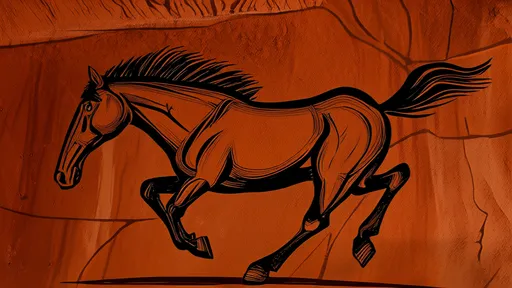
The Lascaux Cave, discovered in 1940 in southwestern France, is one of the most significant prehistoric art sites in the world. Among its many breathtaking depictions of animals, the horses stand out as particularly dynamic and full of life. These ancient paintings, created over 17,000 years ago, capture not just the form of the animals but also their movement, energy, and even their spirit. The artists of Lascaux were not merely recording what they saw; they were conveying a sense of motion, as if the horses were galloping across the cave walls in real time.
The horses of Lascaux are not static figures. They twist, turn, and leap, their legs stretched in mid-gallop, their manes flowing as if caught in an unseen wind. The artists used the natural contours of the cave walls to enhance this sense of movement, allowing the curves and bumps of the rock to suggest the musculature and motion of the animals. Shadows and overlapping lines create depth, making the horses appear to move in and out of the stone. This technique gives the paintings an almost cinematic quality, as though the horses are frozen in a moment of action, ready to spring back to life at any second.
What is especially striking about these depictions is how they differ from later, more rigid forms of animal representation in art. The horses of Lascaux are not posed stiffly or symmetrically; they are caught in mid-motion, as if the artist had observed them in the wild and sought to preserve their vitality. Some horses are shown with their heads turned, their necks arched, as if reacting to something just outside the frame. Others are depicted in groups, their bodies overlapping, suggesting a herd in motion. This attention to natural movement sets Lascaux apart from many other prehistoric art sites, where animals are often rendered in a more static, symbolic manner.
The sense of movement in these paintings may have held deep cultural or spiritual significance for the people who created them. Some researchers believe that the dynamic portrayal of animals was tied to hunting rituals, as if capturing the essence of the horse’s speed and power could grant the hunters success. Others suggest that the motion in the art reflects a belief in the animals’ spirits, as though the paintings were meant to evoke the living presence of the creatures rather than just their physical forms. Whatever the reason, the artists of Lascaux clearly saw movement as an essential part of their work, something that went beyond mere representation.
Modern viewers often marvel at how "advanced" these ancient artworks appear. The horses of Lascaux could easily be mistaken for sketches from a Renaissance artist’s notebook, with their fluid lines and lifelike proportions. Yet they were created thousands of years before the invention of writing, let alone the formal study of anatomy or perspective. This raises fascinating questions about how these early humans perceived the world around them and how they developed such sophisticated techniques without the tools or knowledge we take for granted today. The motion in these paintings is not just a technical achievement—it’s a window into the minds of the people who made them.
Today, the Lascaux Cave is closed to the public to preserve its fragile artworks, but replicas allow visitors to experience the wonder of these ancient masterpieces. As we study the horses and other animals painted on those walls, we are reminded that the desire to capture movement, to freeze a fleeting moment in time, is not a modern obsession. It is a fundamental part of what makes us human, something that connects us across millennia to the artists of Lascaux, who saw the world not as a series of still images, but as a living, breathing, ever-moving tapestry.
By /Aug 12, 2025
By /Aug 12, 2025
By /Aug 12, 2025

By /Aug 12, 2025

By /Aug 12, 2025

By /Aug 12, 2025
By /Aug 12, 2025
By /Aug 12, 2025
By /Aug 12, 2025
By /Aug 12, 2025
By /Aug 12, 2025

By /Aug 12, 2025
By /Aug 12, 2025
By /Aug 12, 2025
By /Aug 12, 2025
By /Aug 12, 2025

By /Aug 12, 2025

By /Aug 12, 2025
By /Aug 12, 2025
By /Aug 12, 2025