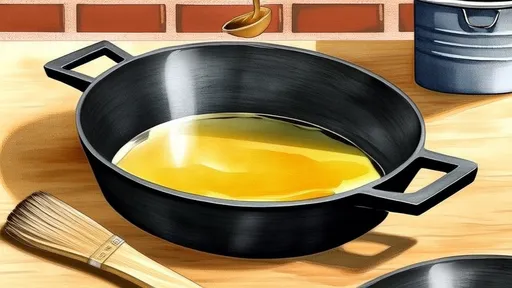
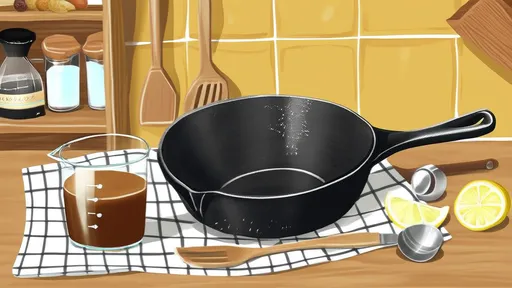
In the world of culinary craftsmanship, the seasoned cast iron skillet holds a place of reverence. Unlike modern non-stick pans that degrade over time, a well-maintained iron pan becomes better with age—its surface evolving into a natural non-stick marvel. The secret lies in an often overlooked ritual: post-cooking oil seasoning. This practice, passed down through generations of chefs and home cooks, bridges the gap between chemistry and tradition.
When you pull a sizzling skillet off the heat, the metal pores stand wide open from thermal expansion. This is the pan’s most vulnerable yet receptive moment. As the Maillard reaction’s aroma still lingers in the air, seasoned cooks reach for their oil cloth. The act isn’t merely about preservation; it’s a dialogue between cookware and caretaker. The heat acts as a catalyst, polymerizing thin layers of fat into a protective shield—a process that mirrors ancient Japanese urushi lacquer techniques, where tree sap transforms into durable coatings through heat and patience.
The choice of oil becomes a personal signature. Flaxseed oil, with its high iodine value, creates a glassy finish but risks brittleness. Lard, the choice of grandmothers worldwide, offers unmatched durability but requires acceptance of animal fats. Avocado oil’s high smoke point makes it a modern favorite, while grapeseed oil strikes a balance between practicality and performance. Each option whispers different stories into the iron’s surface, much like how different woods absorb stains uniquely.
Timing proves crucial. Apply oil too early, and you’ll hear the angry sizzle of evaporating moisture trapped beneath. Too late, and the cooled metal won’t accept the seasoning properly. The sweet spot arrives when the pan feels hot enough to make water droplets dance, but not so scorching that oil instantly carbonizes. This 250-300°F window allows the oil to seep into microscopic valleys without burning away—a nuance commercial seasoning processes can’t replicate.
Contrary to popular belief, the goal isn’t to create a greasy layer. Using too much oil leads to sticky buildup and uneven patches. The professional touch involves wiping the pan as if trying to remove all oil, leaving behind only what the iron willingly absorbs. This technique, known as dry oil seasoning, produces a satin-smooth surface that improves with each use. It’s the culinary equivalent of Japanese shokunin philosophy—perfection achieved through incremental refinement.
The science behind this ritual fascinates materials engineers. When heated oil contacts iron, fatty acids undergo free-radical polymerization, forming cross-linked networks that bond to the metal surface. These hydrocarbon chains create a barrier against oxidation while providing release properties. Interestingly, this mimics how archaeological iron artifacts develop protective patinas over centuries—nature’s own seasoning process.
Regional differences emerge in seasoning practices. In southern China, cooks often use pork fat immediately after stir-frying, believing the pan absorbs flavors that enhance future dishes. French chefs traditionally employ a post-cleaning seasoning method with sunflower oil, valuing its neutral taste. Appalachian cooks swear by multiple thin layers baked in wood-fired ovens. These variations highlight how culinary cultures developed parallel solutions to the same metallurgical challenge.
Modern kitchen trends threaten this tradition. The rise of disposable cookware and silicone-based non-stick coatings discourages maintenance rituals. Yet a quiet rebellion grows—millennials discovering cast iron’s sustainability and Gen Z embracing the mindfulness of cookware care. Social media fuels this revival, with #SeasoningSunday posts showcasing amber-hued pans that glow like stained glass.
The psychological dimension often goes unmentioned. There’s profound satisfaction in maintaining tools that outlive their owners. A 1940s Wagner skillet, its surface black as midnight, carries generations of meals in its patina. This continuity becomes increasingly precious in our disposable age. The simple act of oiling a warm pan transforms from chore to meditation—a tactile connection to countless cooks who performed the same motions across centuries.
Industrial attempts to shortcut this process fail to capture its essence. Pre-seasoned pans from factories lack the depth of hand-built layers. Chemical coatings peel, while hand-rubbed oil bonds molecularly. The difference manifests in performance—a properly seasoned pan develops memory, releasing eggs effortlessly while building fond for sauces. It becomes an extension of the cook’s intention, responsive as a musician’s instrument.
Environmental benefits compound the practical advantages. A single cast iron pan, properly maintained, can replace entire sets of non-stick cookware that end up in landfills. The oil seasoning process requires mere tablespoons of biodegradable fat versus the perfluorinated chemicals used in conventional non-stick production. This sustainability angle resonates in an era of climate consciousness.
Mastering the art requires embracing imperfections. Early attempts may yield spotty surfaces or occasional sticking. But like breaking in leather boots or seasoning a baseball glove, the struggles become part of the object’s story. Each round of cooking and oiling adds character, the pan developing a unique topography that reflects its culinary journey. This stands in stark contrast to mass-produced perfection.
The ritual extends beyond functionality. Running hands over a smoothly seasoned surface delivers tactile pleasure—the iron warm from recent use, the texture like polished stone. It evokes the same satisfaction as sharpening knives to a mirror edge or breaking in a wooden cutting board. These sensory experiences anchor us in physical reality amidst digital overload.
As kitchens become smarter, the humble act of oiling a cast iron pan serves as counterprogramming. It demands attention to temperature, timing, and material—qualities algorithms can’t replicate. In this simple maintenance task lies resistance to culinary homogenization, preserving techniques that transform utilitarian objects into heirlooms. The sizzle of oil meeting hot iron becomes an anthem for craftsmanship in a disposable world.
By /Aug 11, 2025
By /Aug 11, 2025
By /Aug 11, 2025
By /Aug 11, 2025
By /Aug 11, 2025
By /Aug 11, 2025
By /Aug 11, 2025
By /Aug 11, 2025
By /Aug 11, 2025
By /Aug 11, 2025
By /Aug 11, 2025
By /Aug 11, 2025
By /Aug 11, 2025
By /Aug 11, 2025

By /Aug 11, 2025
By /Aug 11, 2025

By /Aug 11, 2025
By /Aug 11, 2025
By /Aug 11, 2025

By /Aug 11, 2025